

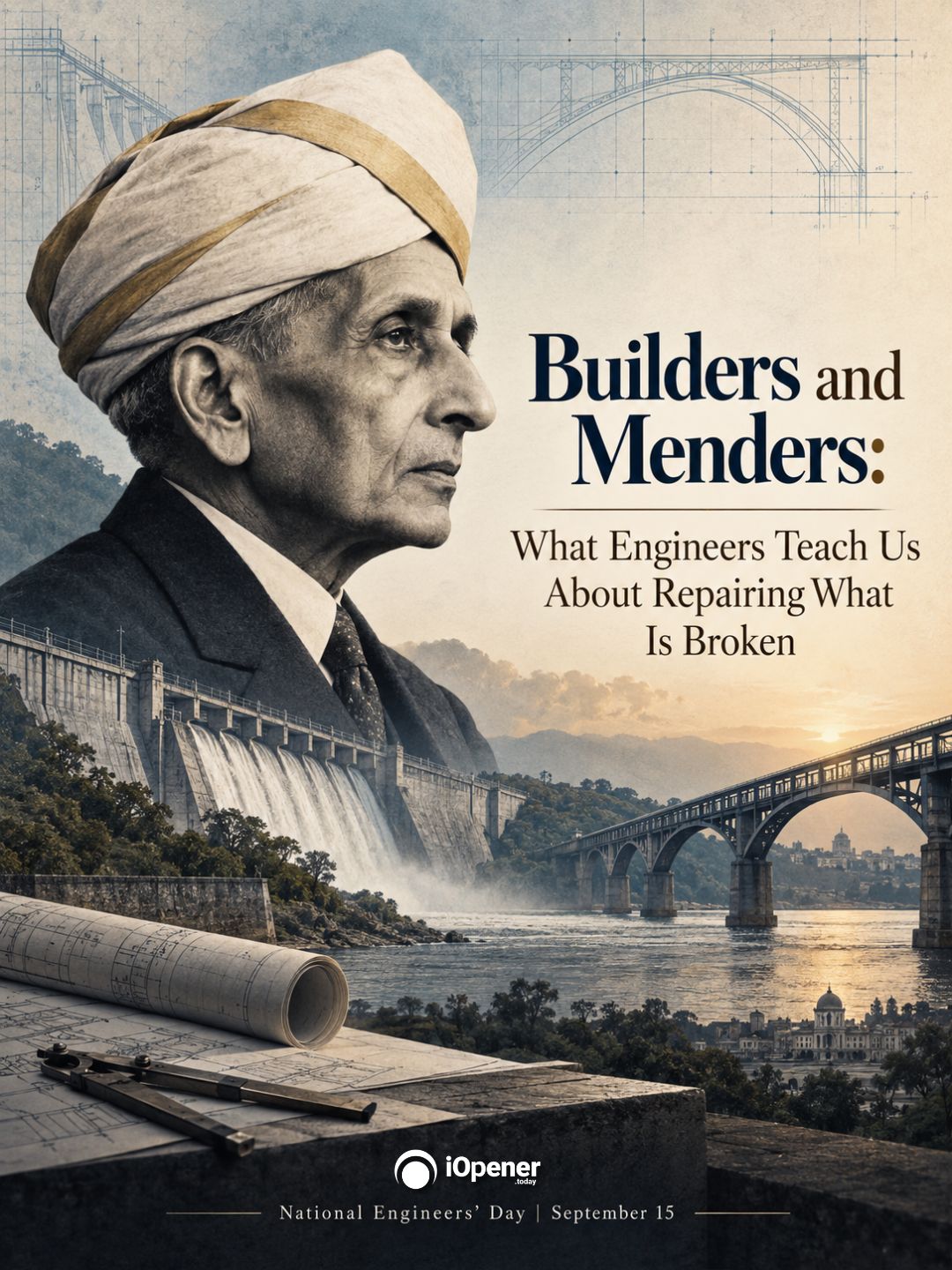
Every September 15, India celebrates Engineers’ Day in honour of Sir M. Visvesvaraya, one of the country’s most respected engineers and nation-builders. His name is attached to dams, flood-control systems, public works and institutions that helped shape modern India.
But there is something about engineering that reaches far beyond bridges, reservoirs and blueprints. At its heart, engineering is about making things strong enough to carry weight. And that is a useful idea for all of us, especially when life gets messy.
Because most of us are building things too: friendships, families, careers, trust, communities, habits and dreams. We may never calculate the load on a bridge, but we still know what it feels like when something we built begins to crack.
This Engineers Day 2026, perhaps the bigger question is not simply, “What are we building?” but, “Will it hold when pressure comes?”
A good engineer does not wait for collapse
Sir M. Visvesvaraya became known for solving practical problems. He worked on irrigation systems, flood protection, water management and major public infrastructure. After the Musi floods of 1908, he contributed to plans that helped Hyderabad think differently about flood protection and urban safety. His work was not just about creating something impressive. It was about creating something dependable and that mindset is worth borrowing.
An engineer looks for stress points before disaster happens. A small crack matters because it can become a much bigger problem later. A weak joint is not ignored because the rest of the structure still looks fine.
Relationships often work in much the same way. A friendship rarely falls apart overnight. More often, something small remains unresolved. A careless comment is never discussed. Messages become less frequent. Plans are repeatedly postponed. Both people notice the distance, but neither wants to have the awkward conversation.
Families can drift in similar ways. Silence becomes easier than honesty. Everyone carries assumptions, and nobody checks whether those assumptions are actually true. We usually wait until things feel serious before responding.
Engineering teaches us another way: notice the strain early.
Repairing is also a form of building
We celebrate people who start things. New businesses, new projects, new careers, new ventures, new movements are all celebrated and applauded. Starting feels exciting because everything still carries possibility.
Repair feels different. Repair means returning to something that did not go as planned. It can involve admitting that we contributed to the damage. It may require patience, humility and a willingness to work on something that will not give us the same excitement as a new beginning.
But repair is not the opposite of building. It is part of building something that lasts. Sometimes repairing a friendship begins with a simple message: “I feel like something has changed between us. Can we talk?” Sometimes it means apologising without adding a long explanation about why you were also right. Sometimes it means asking someone what they actually meant instead of replaying one sentence in your head for three weeks.
These things look small, but small repairs often prevent bigger fractures. And that is the biggest lesson we can learn on this year’s Engineers Day.
Build for pressure, not appearance
Young people today are surrounded by things designed to look successful. Think about a polished LinkedIn profile, a carefully arranged Instagram feed or a résumé full of impressive words, a relationship that looks perfect in photographs or may be a career choice that sounds successful when relatives ask what you do.
But engineers do not design structures for photographs. They design them for load. That is a useful test for the things we are building with our lives. Can your confidence survive rejection? Can your friendships survive disagreement? Can your ambition survive a season when progress slows down? Can your family relationships carry honest conversations? Can your career plans survive a mistake without making you feel like your entire future is finished?
Anything can look strong when nothing is pressing against it. Strength becomes visible when weight arrives.
Not every broken thing needs replacing
We live in a culture that makes replacement easy. If a phone slows down, we upgrade it. If an app becomes annoying, we uninstall it. If something is inconvenient, we move on. Sometimes that is sensible. But the habit of replacement can quietly enter the way we deal with people and problems.
Not every strained friendship needs to end. Not every disappointing semester means you chose the wrong course. Not every mistake at work means you are bad at your profession. Some things need reinforcement rather than replacement. Of course, there are situations where leaving is necessary. Harmful environments, abusive relationships and repeated patterns of damage should not be romanticised in the name of “repair.”
But there is a difference between something that is unsafe and something that is simply difficult. Maturity is learning to recognise the difference.
What are you building that needs to last?
Sir M. Visvesvaraya’s legacy still matters because his work was designed to serve people beyond his own lifetime. That is what good engineering does. It creates structures that remain useful under pressure. Maybe that is a helpful way to think about our own lives.
What are you building right now that you hope will still matter five or ten years from now? A career? A friendship? Trust with your parents? A team? A reputation? A version of yourself that you are still learning to become?
Then build it with more than appearance in mind. Build with care, honesty and responsibility. Pay attention to weak points before they become failures. Do not ignore small cracks simply because nobody else can see them. And when something valuable is damaged, do not be too proud to repair it.
There is something deeply meaningful about choosing to build what serves others, mending what can still be restored, and becoming the kind of person whose work can carry more than personal ambition. The strongest things in life are rarely built for applause. They are built to endure, to protect, to support and to leave something useful behind.
This Engineers Day, let us remember that strength is not the absence of pressure. It is what remains standing when pressure comes. And perhaps the best things we build with our lives are the ones strong enough to carry not only our own weight, but someone else’s too.



 Dear 18-Year-Old Me: Before You Choose Teaching Because You’re “Good at a Subject”