

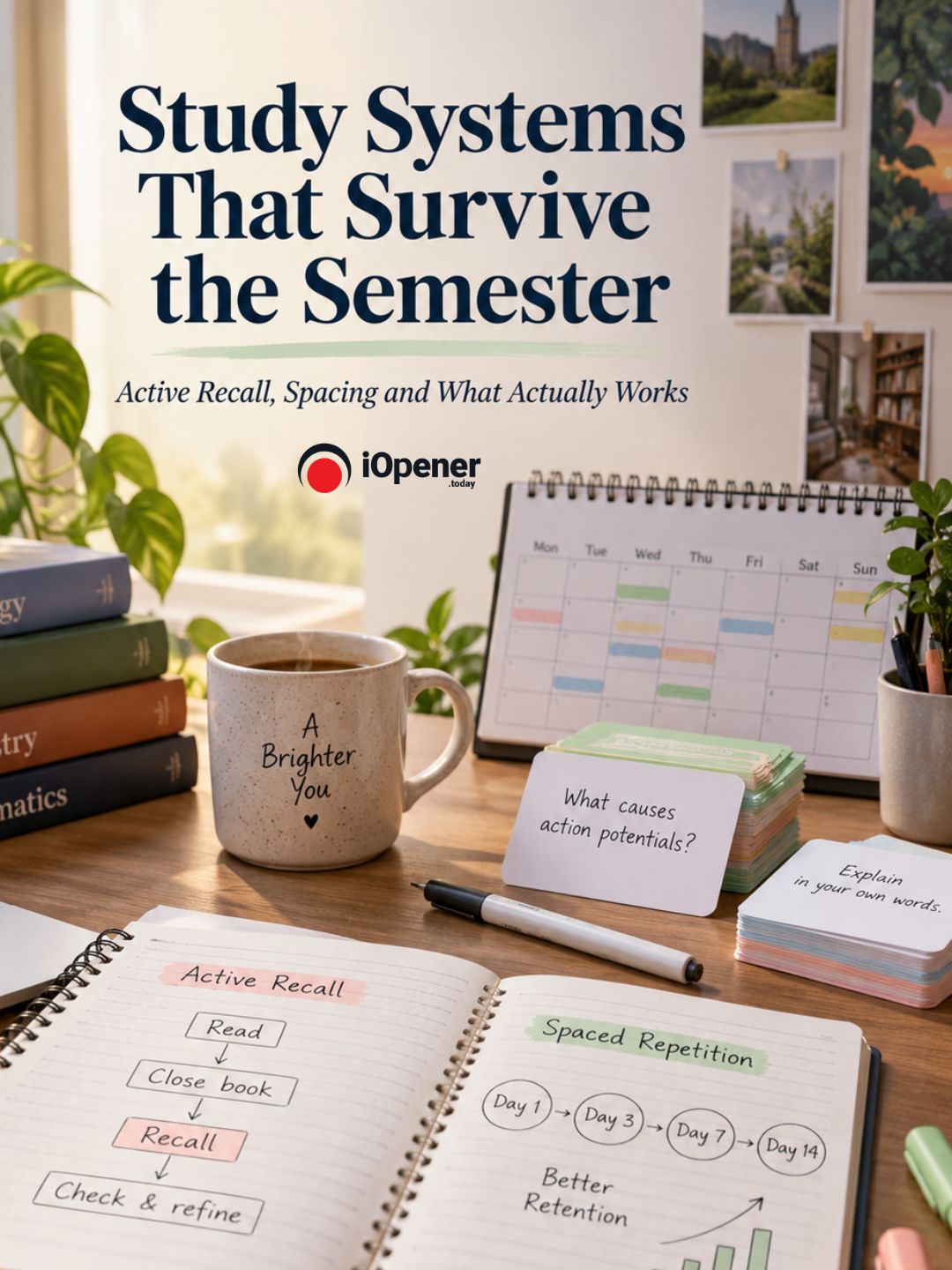
There is a familiar kind of studying that looks productive from the outside. The textbook is open, several lines are highlighted, notes have been read twice, and perhaps a study video is playing in the background. After an hour or two, the chapter begins to feel familiar. Then the next day, someone asks a simple question from the same topic and the answer suddenly feels much harder to produce. For students in Classes 11 and 12, this can be especially frustrating because the syllabus keeps moving. There is always another chapter, another test, another practical, another assignment. When attention is already being pulled in several directions, spending more hours with a book is not always the solution. A better question is whether the way you are studying is actually helping your brain retrieve information later. And that is where the active recall study technique becomes so handy.
Research on learning has repeatedly pointed towards two methods that are particularly useful for long-term retention: retrieval practice, often called active recall, and spaced practice, where revision is spread across time rather than packed into one long session. Neither method is complicated, but both require a shift away from the comfortable habit of repeatedly reading the same material.
Why rereading can fool you?
Rereading is not useless. If a concept is confusing, going through it again can help, and highlighting can be useful for identifying important material. The problem comes when rereading becomes the entire study method.
When you see the same paragraph several times, your brain begins to recognise it. That recognition creates a feeling of familiarity, and familiarity can easily be mistaken for learning. In an examination, however, the textbook is not sitting in front of you. You have to retrieve the idea, formula, argument or explanation yourself. This is why students sometimes leave a study session feeling confident and then struggle in a test. They had become good at recognising the information, but they had not practised bringing it back from memory.
A simple way to check the difference is to close the book after studying a topic and try to explain it without looking. If you can only remember the heading and one or two points, that tells you far more about your preparation than how many times you read the page.
What the active recall study technique actually means
The active recall study technique is simply the practice of trying to retrieve information before looking at the answer again.
Suppose you have just studied photosynthesis. Instead of immediately reading the same section once more, close the book and ask yourself what the main stages are. Write them down, say them aloud, or draw the process from memory. Then reopen the book and compare what you remembered with what was actually there.
The same idea works across subjects. In Biology, draw and label a diagram without looking. In History, reconstruct a timeline or explain why an event happened. In English Literature, describe a character or theme before returning to the text. In Physics or Mathematics, attempt the problem before checking the worked solution. The important part is not getting everything right the first time. In fact, the things you forget are useful because they show you exactly where your learning is weak. A five-minute recall attempt can often tell you more than another twenty minutes of passive reading.
For a teenager with a short attention span, that is good news. You do not necessarily need longer study sessions. You need more purposeful ones.
Study in smaller blocks, but make them count
Instead of sitting down with the vague goal of “studying Chemistry for two hours,” choose a smaller target such as “understand and recall the factors affecting equilibrium.” A focused twenty-five or thirty-minute session can then have a clear structure: spend the first part understanding the concept, close the book and try to recall it, then use the final few minutes to check what you missed. This kind of session is mentally more demanding than rereading, but it is also easier to measure. At the end, you know whether you could explain the topic or not.
Shorter sessions are particularly useful when concentration is limited. The aim is not to force yourself to sit still for three hours simply because that sounds serious. It is to create a period of focused thinking in which your brain has to retrieve, solve, explain or correct something. Your phone may still need to go on silent, but distraction is not always caused by technology. Sometimes the task itself is simply too large. “Finish the chapter” can feel overwhelming. “Recall the three causes of inflation” is something your brain can begin immediately.
Spacing is what stops Monday’s learning disappearing by Friday
Active recall becomes much stronger when it is combined with spacing. Imagine studying a chapter four times on Monday evening. By bedtime, you may know it reasonably well. The problem is that all four encounters happened while the information was still fresh.
A better approach is to study it on Monday, test yourself briefly on Wednesday, answer a few questions on Saturday, and then revisit it again the following week. Each time you return, some forgetting has occurred, which means your brain has to work to rebuild the memory. That process is called spaced practice.
For students preparing for board examinations, entrance tests or semester exams, this matters because one of the biggest problems is not learning a chapter for the first time. It is keeping earlier chapters alive while new ones continue to arrive. Spacing prevents the common cycle of studying something for a unit test, forgetting most of it, and then having to learn it almost from scratch again before finals.
A weekly system that is simple enough to use
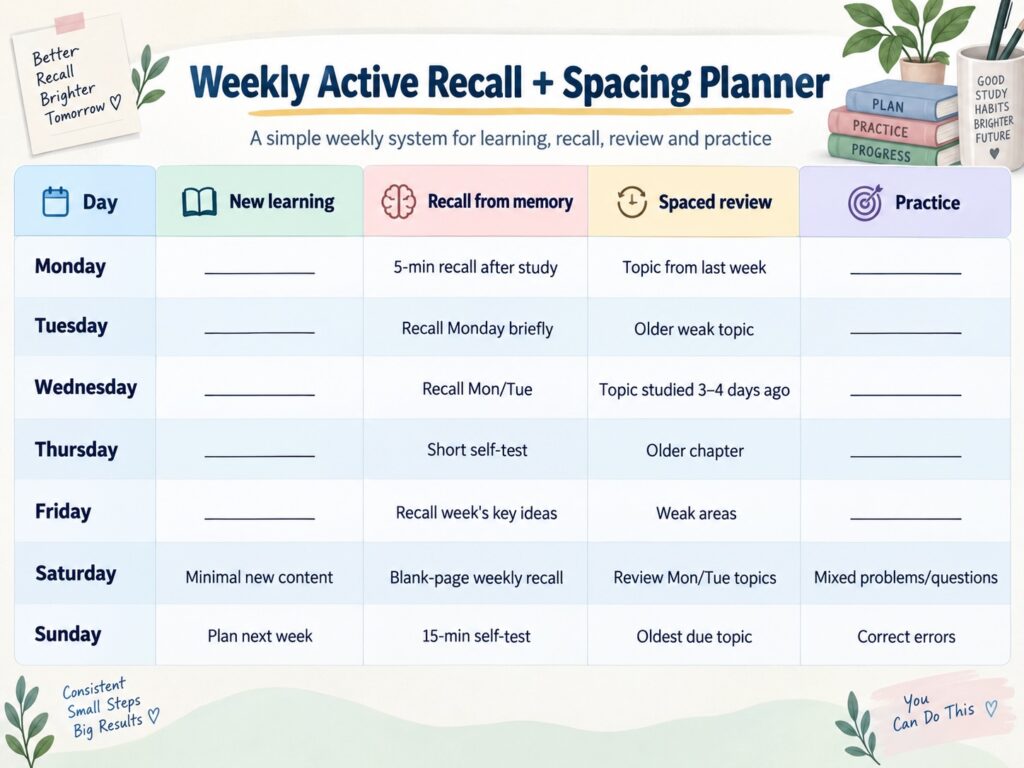
A study planner should not become another complicated project. Its purpose is simply to make sure that every week contains four types of work: learning something new, recalling something recent, reviewing something older and practising questions.
You might learn a Biology topic on Monday and spend five minutes recalling it at the end of the session. On Wednesday, try to explain the same topic without notes. On Saturday, attempt a few exam-style questions. The following week, bring that topic back once more while studying something new.
That is the idea behind the Weekly Active Recall + Spacing Planner included with this article below. You do not have to fill every box perfectly. Use it as a reminder that studying is not complete just because you understood something once. The system works best when it stays simple enough to continue for months rather than only during the week before an exam.
Flashcards are useful, but they are not magic
Flashcards can be effective for formulas, vocabulary, definitions, dates and other information that needs frequent retrieval. But they only work if you genuinely try to answer before turning the card over. If you read the question and immediately reveal the answer, you have turned a recall tool back into a reading tool.
Also, not everything belongs on a flashcard. Essay writing, complex mathematical problems and deeper concepts need explanation and practice. The goal is not to convert your entire syllabus into hundreds of cards. It is to choose the right tool for the kind of learning you need.
Stop judging study by the number of hours
Students often talk about study time as though more hours automatically mean more learning. A six-hour study day sounds impressive, but the more useful question is what happened during those hours. Did you solve something without help? Could you explain a concept without your notes? Did you discover what you did not know? Did you revisit something you learned last week?
Effective studying can sometimes feel less comfortable because it exposes weaknesses. Rereading can make you feel confident because the information is visible. Active recall may make you realise that you have forgotten half the chapter. That is not failure. It is useful information. Finding out today that you cannot remember something gives you time to strengthen it. Discovering the same thing in the examination hall does not.
So the next time you finish studying a topic, do not immediately read it again but try to apply the active recall study technique. Close the book, take a blank sheet, and see what you can bring back from memory. Then check yourself, correct the gaps and return to the topic a few days later. A study system that survives the semester is not built around seeing the same information again and again. It is built around understanding it, retrieving it, allowing a little forgetting, and then retrieving it again.