

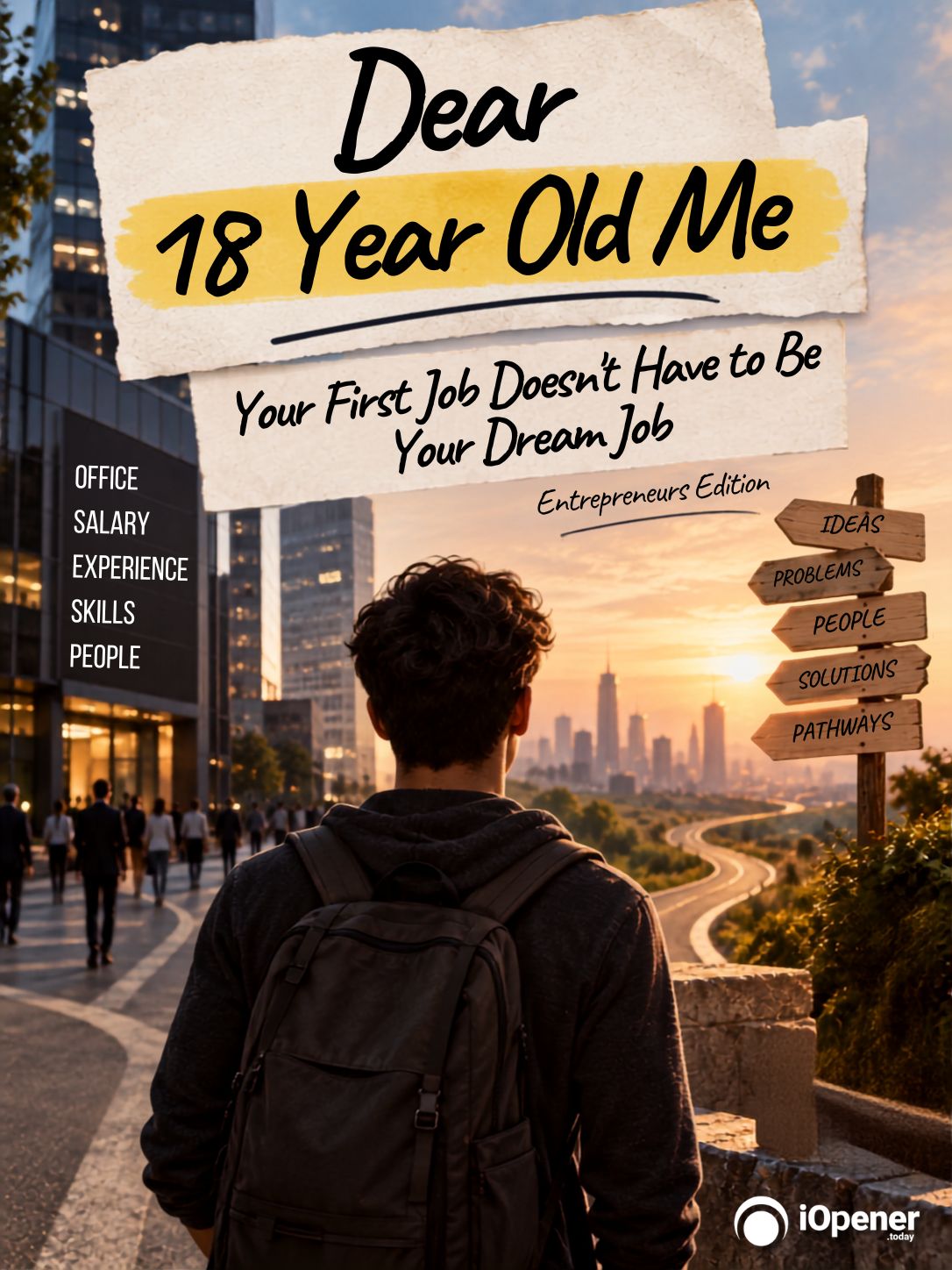
Entrepreneurs Edition · Letter 04/05
The first offer letter can feel far more important than it actually is. You read the job title several times, search the company online, calculate what the salary means per month, and then begin wondering what everyone else will think when you tell them where you are working. Somehow, the first job starts feeling like a verdict on the rest of your career.
Is this a good enough beginning? Am I settling too early? Should I wait for something better? What if I choose the wrong opportunity and fall behind?
Ten years later, many people discover that their first job mattered greatly, but not because it predicted where they would eventually end up. It mattered because it was often the first place where they learned how work, people, money, customers and organisations actually function. For anyone who dreams of building something of their own one day, that education can be more valuable than it first appears.
Dear eighteen-year-old me,
You are going to underestimate small beginnings because they do not look impressive enough. There will be opportunities you almost reject because the organisation is not famous, the office is not exciting, or the job title does not sound like the future you imagined for yourself. You will compare your beginning with someone else’s polished LinkedIn announcement and quietly wonder whether you are already making the wrong move.
I wish you would worry less about how the first job looks and pay much more attention to what it can teach you. Your early years of work are not only about collecting salary slips or adding another line to your résumé. They are also your first real opportunity to observe how the working world functions from the inside. College will teach you concepts, but work will teach you what happens when those concepts meet deadlines, budgets, difficult customers, uncertain decisions and imperfect people.
You will begin noticing things nobody taught you in a classroom. You will see how a good manager behaves when a project goes wrong, why some teams trust each other and others do not, why customers complain about one thing when the real frustration is somewhere else, and why certain people become indispensable even though they are not the loudest or most impressive people in the room.
If you ever want to become an entrepreneur, pay attention to all of it.
Treat your first job like paid field research
You do not need to love every part of your first job for it to be valuable. In fact, some of the things that annoy you most may teach you the most. Watch how decisions are made. Learn where money comes from and where it disappears. Notice how people communicate when deadlines become uncomfortable. Pay attention to the process everyone complains about but nobody seems willing to change.
Volunteer for something slightly outside your role once in a while. Learn to write an email that actually helps someone make a decision. Understand why one meeting moves a project forward while another simply fills an hour. Learn to receive criticism without treating every correction as a personal attack, and learn how to disagree without turning disagreement into conflict.
None of this sounds particularly glamorous, which is probably why it rarely appears in motivational videos about entrepreneurship. But these are the skills that make people trust you, work with you and eventually take a chance on something you build. Your first job can become a kind of field research into how the real world works.
AI will make starting easier, but choosing what to build harder
By the time you seriously begin thinking about entrepreneurship, the barrier to starting something will have changed dramatically. AI will allow very small teams, and sometimes even one person, to do work that once required an entire department. You will be able to research markets faster, analyse customer feedback, generate early designs, build prototypes, write copy, automate repetitive tasks and test ideas at a speed that would have seemed unrealistic when you were eighteen. That will make starting easier. It will not necessarily make building something valuable easier.
When almost everyone has access to powerful tools, the advantage shifts. The question will no longer simply be, Can I build this? More often, it will be, Is this actually worth building? And that answer rarely appears because someone sat alone trying to invent the next brilliant startup idea. It usually begins with noticing.
Maybe you notice the customer who keeps complaining about the same frustrating process. Maybe you see employees doing manually what software could simplify. Maybe you realise an entire group of people is being poorly served because nobody designing the solution truly understands them. That is why I want you to look carefully at even the job you currently think is beneath your ambitions. Your first job may introduce you to the problem you eventually spend years solving.
Don’t confuse a stepping stone with a prison
There is one warning I need to add, because telling you to learn from your first job does not mean you should stay anywhere indefinitely. Good first job career advice has to hold two ideas at the same time: do not dismiss an opportunity simply because it is not your dream job, but do not remain in a damaging environment just because somebody told you that young people must “pay their dues.” There is a difference between being stretched and being diminished.
A demanding job can teach you resilience. A difficult manager may teach you what kind of leader you never want to become. But an environment that repeatedly harms your health, dignity or sense of worth is not automatically valuable just because it is difficult. Ask yourself whether you are still developing. Are you learning? Are you gaining responsibility? Are you becoming better at your craft? Are you meeting people who challenge the way you think? Is the experience moving you somewhere, even if slowly?
If the answer stays no for a long time, leaving may not be failure. It may simply mean the lesson has been learned.
Your career will probably look less like a ladder than you imagine
At eighteen, you picture a career as a neat staircase: intern, junior, senior, manager, success. Real careers rarely behave that well. They look more like maps drawn by someone who changed their mind halfway through. People move sideways, switch industries, return to study, join startups, leave startups, take breaks, discover jobs they did not know existed, or build companies around problems they encountered years earlier. Some choices make sense only when you look backwards.
That is why I wish you would place less pressure on your first job. Take it seriously, but do not treat it as a permanent definition of who you are. Work hard, observe carefully, use every new tool available to you, including AI, and keep paying attention to people and problems. Especially the problems.
One day, you may realise that the most valuable thing your first job gave you was not the title on your résumé or even the salary in your bank account. It was a front-row seat to how people work, what frustrates them, what they value and what still needs fixing. And if you eventually become an entrepreneur, that understanding may matter far more than having had an impressive beginning.
Take the first job if it gives you something useful to learn. You do not need your first workplace to look like your dream. Sometimes it is simply the place where you begin discovering what you might one day build.
With considerably less anxiety about impressive beginnings,
You, ten years later.



 Dear 18-Year-Old Me: Build a Life, Not Just a Résumé