

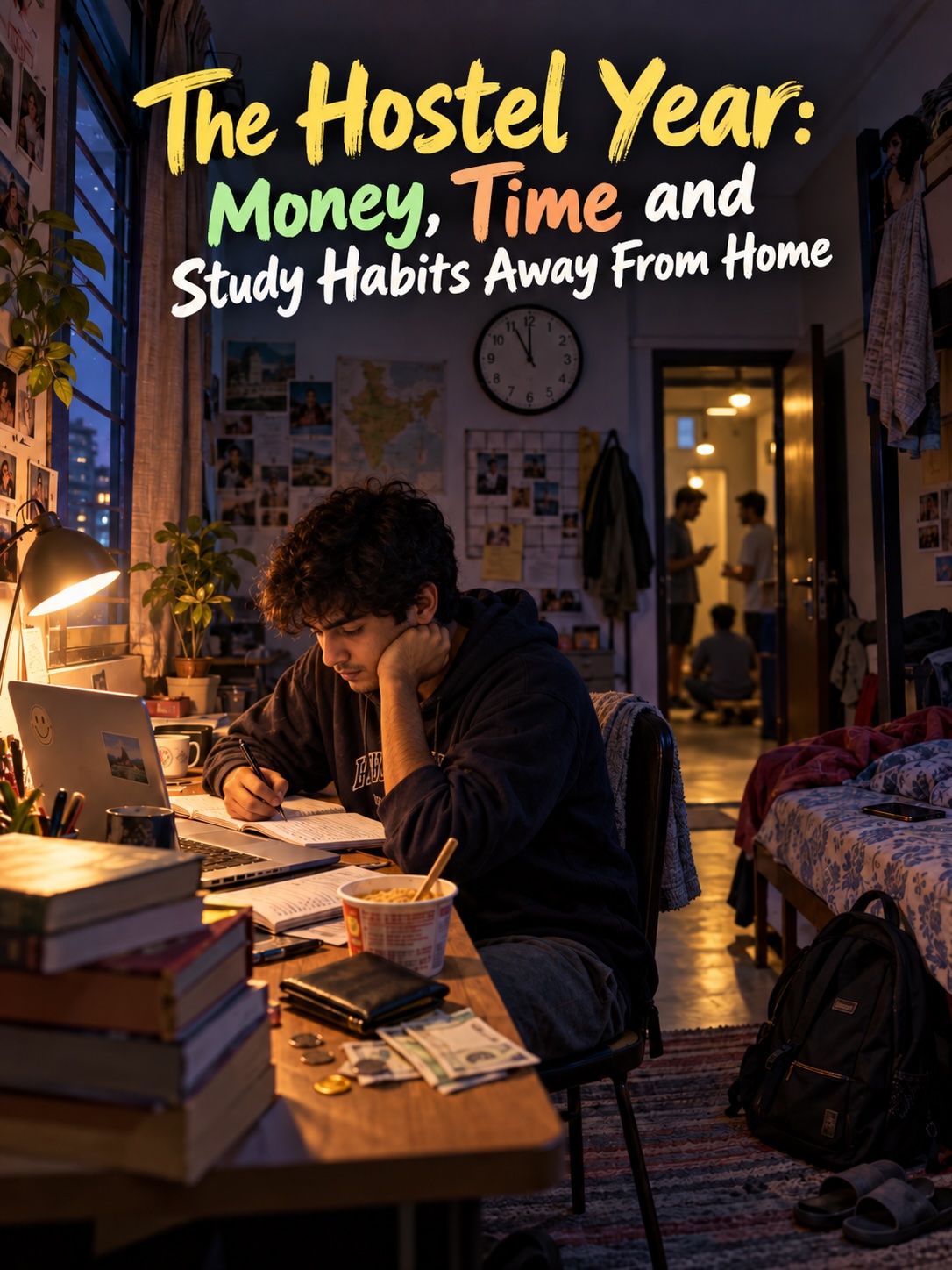
Hostel life for students, especially during those initial years, is always a rollercoaster ride. There is a moment in almost every new hosteller’s life when the freedom suddenly becomes real. It may happen late one evening when nobody asks why you are still awake and nobody reminds you that there is class early next morning. The hostel corridor is always buzzing with life. Someone has music playing, someone planning for an evening outing, and for the first time you realise that almost every decision for the next few hours is entirely yours.
Moving away from home is one of the first major experiences of independence for many students. Yet what often gets missed in all the conversations about new friends, freedom and campus life is that home was quietly doing far more for you than providing a place to sleep. Much of your routine had been built into the household without you noticing. Meals happened at predictable times, somebody usually knew when you had been sleeping too little, basic expenses were absorbed into the rhythm of family life, and even your study habits often existed inside a structure created partly by other people.
Hostel life removes much of that structure at once. What remains is freedom, but also the responsibility of deciding what to do with it. In many ways, your first year away from home is less about learning how to live alone and more about learning how to manage three resources that become increasingly important in adult life: money, time and attention.
The money usually disappears quietly
Most students do not ruin their monthly budget through one spectacularly bad financial decision. The problem is usually much less dramatic. It is a cab because you woke up too late to take the bus, a snack because dinner was disappointing, a late-night delivery, a subscription you forgot about, or a small online purchase that felt too inexpensive to count as spending.
This is what makes hostel money tricky. A ₹150 expense rarely feels serious enough to think about, but an unnecessary ₹150 every day becomes roughly ₹4,500 over a month. The individual decisions feel harmless while the cumulative effect arrives somewhere around the final week, when suddenly every remaining rupee has acquired strategic importance.
You do not need to turn college life into an accounting exercise or feel guilty every time you spend money. Some of the most memorable parts of your hostel years will cost money and will be worth every rupee. What helps is simply becoming aware of your burn rate, the speed at which money disappears.
A simple way to think about it is to divide your monthly money mentally into three parts: what you must spend, what you want to spend, and what needs to remain for future you. Future you is not some distant adult version of yourself. It is the person who still needs transport, food, and basic dignity on the 27th of the month. The real lesson is not budgeting for its own sake. It is learning that financial independence begins long before you earn a salary. It begins when nobody is watching how you spend.
Time feels different when nobody is ending the day for you
Hostel evenings also have a strange relationship with time. At home, the household itself often signals that the day is ending. Lights go off, conversations become quieter, parents begin asking why you are still awake, and tomorrow starts entering everyone’s mind.
A hostel can feel completely different. Midnight may still seem early because half the floor is awake, and the idea that tomorrow morning has consequences can remain pleasantly theoretical until the alarm rings.
Some of your best hostel memories may genuinely happen after midnight. The unplanned conversations, birthday surprises are part of the experience, and turning hostel life into a strict timetable would miss the point entirely. The issue begins only when every night becomes an exception.
One useful way of thinking about sleep is to treat every late night as a small loan taken from the next day. Sometimes the loan is worth taking. The problem comes when you borrow every night and expect tomorrow to keep absorbing the cost. Eventually that cost appears as missed classes, reduced attention, irritability, poor memory and the strange feeling of being tired even before the day has properly begun.
You do not need to schedule every hour, but a few anchors help enormously: a reasonably consistent waking time and some point in the evening when you begin behaving as though tomorrow actually exists. Freedom becomes much easier to enjoy when every morning is not spent recovering from the night before.
Hostel life has its own attention economy
It is easy to blame the phone for poor concentration, but hostel life introduces another kind of distraction that is more social than digital. Your environment becomes highly interruptible. A friend walks in without knocking, somebody wants to show you something, another person asks whether you are coming downstairs, your roommate starts a conversation, and the group chat suddenly comes alive just as you have begun concentrating.
This is one of the reasons studying away from home can feel surprisingly difficult even when you have more freedom over your time. The challenge is not always motivation. Sometimes it is simply that your attention never remains in one place long enough to do serious work. The answer is not to become antisocial or spend your first year hiding in the library. What you need is the ability to become temporarily unavailable without feeling guilty about it.
Think of it as creating library mode, whether or not you are actually in a library. For thirty or forty-five minutes, notifications are silenced, your friends know you are working, and you finish one clearly defined task before returning to everything else. Learning to say, “Give me forty minutes, then I’ll come,” may turn out to be a more useful college skill than creating elaborate study timetables you never follow. The deeper lesson here is that friendship does not require permanent availability. You can be present for people and still protect your attention.
Your study system has to survive real hostel life
Many students carry school-style study expectations into college. They assume they will eventually sit down for a long, perfectly quiet session once everything settles. The problem is that hostel life rarely settles in the way you imagine. Someone may be on a call, another room may be celebrating something, dinner has a fixed timing, your friend needs your charger, and the Wi-Fi can suddenly play hide and seek.
If your study plan only works when you have three uninterrupted hours, total silence and high motivation, it probably will not survive very long. Smaller, more specific study tasks tend to work better. Instead of telling yourself to “study Physics tonight,” decide to solve five problems. Instead of vaguely planning to revise Biology, choose one topic and try to recall it without notes. Rather than waiting for exam season to relearn everything, return to older material in short intervals across the week.
The goal is not to study endlessly. It is to create a study habit that can function even when your environment is imperfect. A focused thirty-five-minute session that actually happens is more valuable than an impressive three-hour plan that keeps getting postponed. In hostel life, the best study system is not the most ambitious one. It is the one you can still follow on an ordinary Wednesday.
Living with other people will teach you things about yourself
One of the more unexpected parts of hostel life is discovering habits you never knew were habits. Perhaps you leave the light on, talk loudly on the phone, set five alarms before waking up, borrow things and forget to return them, or have a definition of cleanliness that your roommate considers deeply concerning.
At home, many small irritations were absorbed by family relationships. Somebody quietly replaced the empty water bottle, moved your things or reminded you repeatedly until something got done. In a hostel, the same empty bottle can become a surprisingly serious diplomatic issue. Living with people who were raised differently from you forces you to learn how to communicate expectations instead of assuming them. Conversations about sleeping times, cleaning, visitors, shared items and money may feel unnecessarily formal during the first week, but five minutes of awkward honesty early on can save months of silent irritation later.
This part of hostel life is not separate from your education. You are learning how to share space, negotiate boundaries, apologise, compromise and live with people who do not think like you. Those skills will follow you into workplaces, marriages, communities and almost every part of adult life.
Homesickness does not always announce itself as homesickness
Missing home can also look very different from the way media portrays it. You may not spend evenings staring sadly at family photographs. Sometimes homesickness appears as irritation with the city, the food, the weather, the hostel or the people around you. Home begins to look perfect in memory simply because the new place still feels unfamiliar.
For someone else, it may look like withdrawing socially, sleeping too much, calling home constantly, or spending impulsively because buying something creates a temporary sense of comfort. The mistake is to think that adjusting means forcing yourself to stop missing home. A better approach is to create a few familiar rhythms inside the unfamiliar place. Perhaps Sunday evening becomes the regular call home. You find one nearby place where you enjoy walking. You maintain a prayer, exercise or reflection routine. You arrange one corner of the room so that it feels recognisably yours.
Then, almost without noticing, the new city begins collecting memories. The shopkeeper recognises you, you learn which mess meal to avoid, you stop needing Google Maps for familiar routes, and somebody begins knocking on your door without sending a message first. You have not replaced home. You have simply begun building another place where you belong.
Your first tiny republic
Perhaps the most useful way to think about your hostel year is to imagine that you are running your first tiny republic. For the first time, you are simultaneously responsible for its finances, education, health, relationships and, on certain mornings, disaster management. You will not run it perfectly, and that is fine. You will probably overspend one month, waste an evening you meant to use well, forget something important, discover an assignment deadline far too late, and occasionally eat something that should not count as dinner. Those mistakes are part of the education.
The deeper point of the hostel year is not proving that you can live without your family. It is discovering whether some of the good habits that once existed around you can gradually become habits within you. At home, many of your good routines were partly your parents’ routines. Hostel life is where you begin finding out which ones have actually become yours.
You may arrive believing that independence means nobody telling you what to do. By the time you leave, you may discover that real independence is something quieter and more demanding: learning what needs to be done even when nobody tells you.



 Peace Is Not the Absence of Conflict. It Is the Presence of Courage.