


Career Talk Series | Part 2 of 5
The Most Important Career Data Is Already Inside You
There is a question that has quietly killed more career paths than bad grades ever did. It goes like this. Someone mentions they love writing, or gaming, or psychology, or fashion, or telling stories, or designing things. And almost immediately, someone else in the room says it. The sentence that shuts everything down.
“But can you actually make a career out of that?”
It is not always said with cruelty. Sometimes it comes from a parent who is worried. Sometimes from a teacher who means well. But the effect is the same. You learn, early and efficiently, to distrust your own interests. You learn to treat the things you love as hobbies at best, distractions at worst. And then you go looking for a career in the place that feels the safest, not the truest.
That is where most career confusion actually begins. Not from a lack of options. From a trained habit of ignoring yourself.
Here is what the research says, and it is worth paying attention to. Decades of work in vocational psychology show that people experience significantly more satisfaction, stability, and motivation when their career aligns with their natural interest profile. Not their grades. Not their parents’ preference. Their interests. The things they are drawn to before anyone tells them what to value.
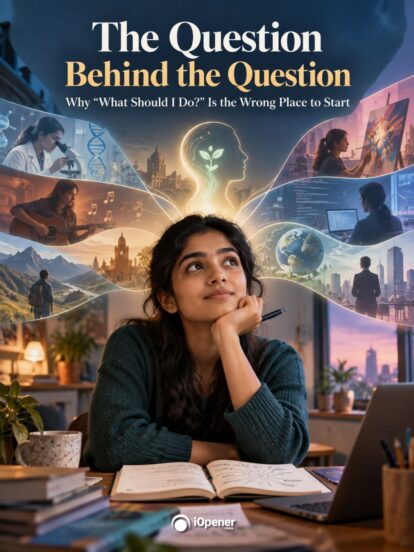
And here is the part that tends to surprise people. Interests are not just preferences. They are patterns. And patterns, when you learn to read them, become direction. Think about it this way. Someone who spends hours editing videos is not just someone who likes editing. They probably love storytelling, pacing, emotion, and the way a sequence of images can change how someone feels. That is a communication instinct.
Someone who organizes every group event, who remembers everyone’s dietary restrictions and shows up with backup plans, is not just being helpful. They are demonstrating a natural pull toward coordination, leadership, and care.
Someone who reads Wikipedia for fun and disappears into rabbit holes about random topics is not wasting time. They have a strong investigative instinct that almost every research-based, strategy-based, and analytical field is hungry for.
The interest itself is rarely the destination. It is a clue pointing toward something deeper. This is where the present Generation has a specific and very real problem. You are the first generation to grow up with unlimited access to everyone else’s career in real time. You watch doctors who became influencers. Engineers who launched startups at 24. Creators earning a living from a niche you did not know existed last Tuesday. People your exact age building brands, shipping products, and posting about passive income from co-working spaces in Bali.
And instead of making career decisions easier, all of that access makes them harder. Because clarity does not come from watching everyone else’s path. It comes from paying attention to your own recurring patterns. Every time you look outward for direction, you move further away from the data that actually matters, which is already inside you.
So here is the practical step for this week, and it is simpler than it sounds. Open your YouTube watch history. Go back as far as you can stand to look. Do the same with your saved Instagram posts, your Spotify playlists, your most visited subreddits, the podcasts you actually finish, the books you read past chapter three. Do not judge any of it. Do not filter for what looks impressive or sensible. Just look. Then ask one question: what themes keep showing up? Not what you think you should be interested in. Not what your family approves of. What actually keeps pulling your attention back, unprompted, across different moods and different years? Write those themes down. Three words is enough. Communication. Systems. People. Aesthetics. Ideas. Justice. Whatever it is.
Because here is the thing about interests. They create energy. And energy is what gets people through the hard parts of any career, the boring meetings, the slow seasons, the moments where nothing is working. People who are internally connected to their work last longer and go further. Not because they are more talented. Because they are more fuelled.
Your interests are not random. They are not accidents. They are data. And you have been collecting that data your whole life without realizing it. Self-awareness is the single most underrated career skill, and the research is not subtle about it.
A 2018 study by organizational psychologist Tasha Eurich found that while 95% of people believe they are self-aware, only about 10 to 15% actually meet the criteria when tested. We think we know ourselves. We largely don’t. It’s just a gap worth closing, because the more clearly you see yourself, the better your decisions become, in career and everywhere else.
Now here is the twist. Two people can share almost identical interests and still need completely different ways of working. Same field. Same passion. Completely different environments, rhythms, and roles.
That is where ……………suspense! something comes in.
And that is exactly where we are going next week in the Career Talk Series


 Not Everyone Is Built for the Same Kind of Success